

Every organization has employees with the potential to lead and drive future growth, but that potential isn’t always visible through traditional measures like tenure or current performance. Identifying high-potential employees early requires more than observation. It requires a structured approach grounded in talent assessment and measurable indicators of how individuals think, adapt, and perform.
Organizations that take this approach create greater clarity around leadership potential and make more confident development decisions. The result is a stronger succession pipeline, faster leadership readiness, and a more stable foundation for long-term growth.
What Makes an Employee “High-Potential”?
High-potential employees are defined by more than strong performance in their current role. They show the capacity to take on greater responsibility, adapt to new challenges, and lead effectively over time.
Three factors consistently define leadership potential:
- Ability: The capability to perform at a high level and take on more complex responsibilities
- Aspiration: The motivation to grow, lead, and take ownership of outcomes
- Engagement: A sustained commitment to the organization and its goals
Within those areas, several traits tend to stand out.
Adaptability
High-potential employees adjust quickly to change and remain effective in new or uncertain situations.
Strategic Thinking
They connect day-to-day work to broader business objectives and consider long-term impact when making decisions.
Emotional Intelligence
They understand how their actions affect others and can navigate relationships, communication, and team dynamics effectively.
Learning Agility
They seek out feedback, apply it, and improve quickly. They are comfortable stepping into unfamiliar situations and building new skills.
Decision-Making Under Pressure
They maintain clarity when stakes are high. Rather than slowing down or deferring, they make informed decisions with confidence and take ownership of outcomes.
Courageous Leadership
They are willing to act when it matters. This shows up in how they address challenges directly, make difficult calls, and lead with conviction even when conditions are uncertain.
These characteristics signal readiness for future leadership roles, even when an employee is still early in their career path.
Why Is It So Difficult to Identify High-Potential Employees?
Many organizations recognize the importance of identifying high-potential employees, but the process often lacks consistency and structure.
One of the most common challenges is over-reliance on manager intuition. While experience and judgment are valuable, they can lead to inconsistent evaluations across teams and departments. Two managers may define potential very differently, which creates gaps in how employees are identified and developed.
Performance reviews also introduce complexity. High performance in a current role doesn’t always translate to leadership potential. Employees who excel in execution may not have the same strength in strategic thinking or decision-making at a higher level.
Bias can also influence outcomes. Employees who are more visible, vocal, or aligned with leadership styles may be recognized more quickly, while others who demonstrate potential in less obvious ways are overlooked.
Another challenge is visibility across the organization. Employees who contribute in cross-functional settings or informal leadership roles may not be captured through traditional evaluation methods, even though they demonstrate strong leadership behaviors.
Without a clear framework, identifying high-potential employees becomes inconsistent and difficult to scale.
How Can Data Help Identify High-Potential Employees Earlier?
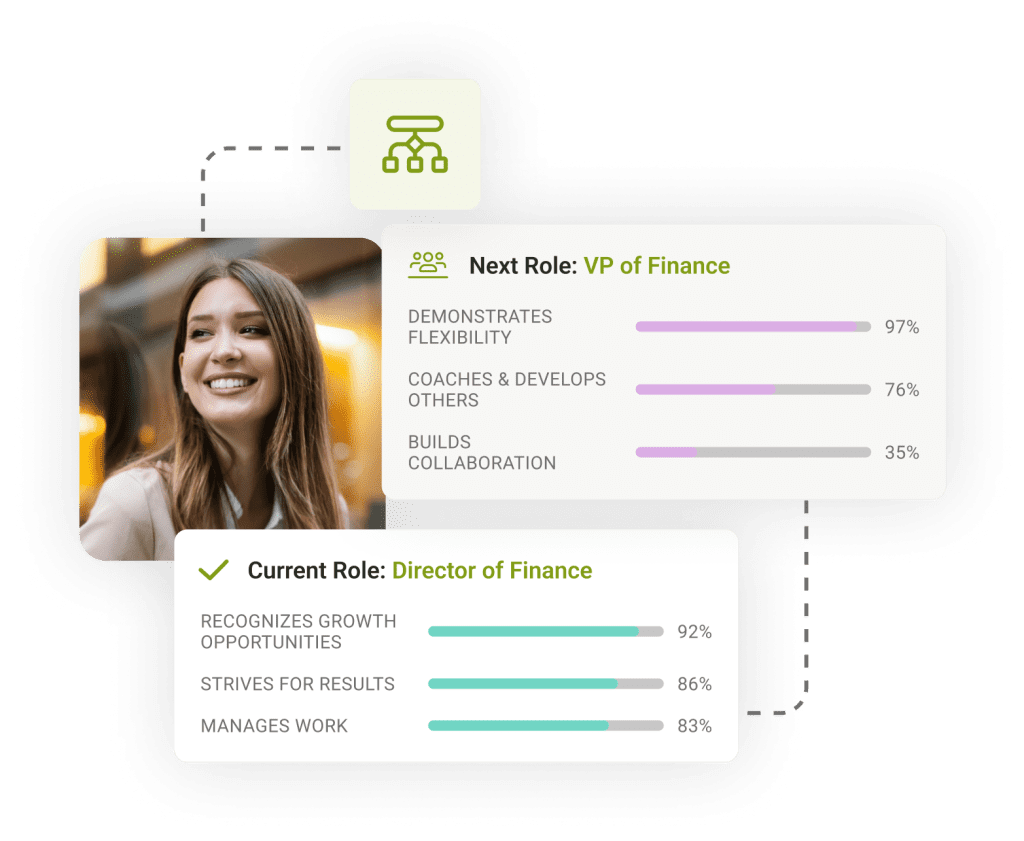
Data-driven approaches bring structure and clarity to identifying leadership potential. Instead of relying on isolated observations, organizations can evaluate employees using consistent, measurable criteria.
Behavioral Assessments
Talent assessments provide insight into how individuals think, make decisions, and interact with others. These assessments help identify leadership styles, problem-solving approaches, and communication patterns that align with future leadership roles.
Performance Data Combined with Potential Indicators
Performance metrics remain important, but they are most effective when paired with indicators of future capability. This includes how employees handle complexity, take initiative, and respond to new challenges.
Multi-Rater Feedback
Peer and stakeholder feedback offers a broader view of an employee’s impact. It highlights strengths that may not be visible to a single manager and provides a more complete picture of leadership readiness.
AI and Predictive Analytics
AI can analyze patterns across high-performing and high-potential employees to identify common traits and behaviors. These insights help organizations recognize employees who demonstrate similar patterns, even if they are not yet in leadership roles.
Together, these methods create a more accurate and scalable approach to identifying high-potential talent.
How Do You Integrate Talent Insights into Succession Planning?
Identifying your high-potential employees is only the first step. The real value comes from how those insights are used to build a stronger leadership pipeline.
Organizations that integrate talent data into succession planning take a more intentional approach to development.
Prioritizing Leadership Development
Data helps organizations focus their investment on employees who show the strongest potential for leadership roles. Development programs become more targeted and aligned with future needs.
Creating Stretch Opportunities
High-potential employees benefit from experiences that challenge them. Assignments that require cross-functional collaboration, decision-making under pressure, or leadership responsibility help accelerate growth.
Pairing with Mentorship
Mentorship connects emerging leaders with experienced leaders who can provide guidance, perspective, and feedback. This supports both skill development and organizational alignment.
Tracking Progress Over Time
Leadership potential evolves. Continuous tracking and reassessment allow organizations to refine development plans and ensure that employees are progressing toward readiness for future roles.
When these elements are aligned, succession planning becomes more proactive and less reactive.
What Does This Mean for Long-Term Talent Strategy?
Organizations that identify and develop high-potential employees early create a stronger foundation for growth. They reduce the risk of leadership gaps, improve internal mobility, and build a more engaged workforce.
A structured approach to talent assessment and succession planning allows organizations to:
- Identify leadership potential earlier in an employee’s career
- Develop future leaders with greater precision
- Create a consistent pipeline of ready talent
- Align development efforts with long-term business goals
As roles evolve and leadership demands increase, the ability to recognize and develop potential becomes a key differentiator.
Building a Stronger Leadership Pipeline with Confidence
High-potential employees are not always the most obvious candidates. They are identified through patterns in how they think, adapt, and contribute over time.
XBInsight brings together science-based talent assessment and AI-driven insights to help organizations identify leadership potential with greater accuracy. By combining behavioral data, performance indicators, and predictive analytics, organizations can move beyond intuition and build a more consistent, scalable approach to succession planning.When leadership potential is identified early and developed intentionally, organizations create a pipeline that supports growth, stability, and long-term success. Request a demo, and see how we can better help you identify the strongest potential leaders.