

Senior leadership will change over time. What determines long-term stability isn’t whether someone eventually leaves, but whether the organization is ready when it happens.
Poorly managed executive transitions can be extraordinarily expensive. Harvard Business Review has estimated that badly handled CEO transitions can erase nearly $1 trillion in market value annually across S&P 1500 companies. Even outside the C-suite, leadership gaps create operational slowdowns, stalled initiatives, and cultural instability. When critical roles sit vacant or are filled by unprepared successors, performance declines quickly.
Succession planning that truly works is an ongoing strategic discipline. It strengthens business continuity by identifying, developing, and validating future leaders well before disruption occurs.
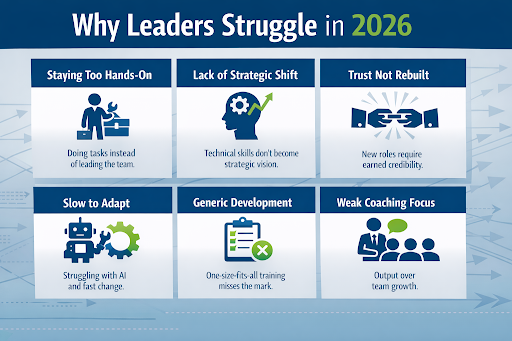
Why Leaders Struggle in 2026 according to Forbes 2026 and McKinsey & Company 2025:
- Operating at the Wrong Level: Leaders move up but keep working at the depth of their previous role, staying hands-on instead of thinking ahead, which limits team growth and slows decision velocity.
- Strategic Gap: Technical expertise doesn’t automatically translate into enterprise thinking. Many leaders aren’t prepared to navigate ambiguity, long-term tradeoffs, or stakeholder complexity.
- Credibility Reset Blind Spot: Success in one role doesn’t carry forward by default. Leaders who don’t intentionally establish trust in new environments often face resistance they didn’t anticipate.
- Change Fatigue in an AI-Driven World: Rapid shifts in technology and workflow expectations require continuous learning. Leaders who resist adapting quickly lose relevance and influence.
- One-Size-Fits-All Development: Broad leadership programs fail when they aren’t anchored to the actual skills required for a specific role or business context.
- Underinvesting in Team Growth: Leaders who focus only on deliverables and short-term performance often overlook coaching, succession readiness, and long-term capability building.
Start Early and Plan Continuously
Effective succession planning begins long before a resignation letter appears. Organizations that wait until a leader signals departure are already behind.
A strong succession strategy is continuous. It evolves alongside business strategy, restructuring, and market shifts. Leadership requirements five or ten years from now will not look identical to today’s role descriptions. If the organization’s strategy changes, succession profiles must change with it.
That requires regular review. Annual talent reviews are a minimum. Many organizations benefit from biannual assessments of bench strength and readiness. When succession planning becomes part of the regular strategic rhythm of the organization, it remains relevant and aligned to future direction rather than anchored to outdated role definitions.
Further reading: How Data and Science Transform Succession Planning
Define the Future Before Identifying the Successor
One of the most common mistakes in succession planning is confusing replacement planning with future readiness.
Replacement planning asks, “Who can step into this job tomorrow?” Effective succession planning asks, “What will this role demand in three to five years?”
Organizations must identify critical roles tied directly to business continuity, revenue generation, operational resilience, and long-term strategy. Then they must define the performance-based competencies required for success in those roles.
This is where rigor matters. Grounded in I/O Psychology and psychometric validation, competency modeling allows organizations to define measurable leadership expectations. Rather than relying on vague descriptors like “executive presence,” effective succession planning identifies specific capabilities such as decision-making under pressure, strategic thinking, learning agility, accountability, and cultural alignment.
When future leadership requirements are clearly defined, evaluation becomes objective rather than political.
Evaluate Potential with Structure and Evidence, Not Assumption
High performance doesn’t automatically equal leadership readiness. Many succession failures occur because organizations promote individuals who excel in execution but struggle in ambiguity, complexity, or enterprise-level decision-making.
Strong succession planning casts a wide net. Each critical role should have multiple potential successors, not a single presumed heir. This approach reduces concentration risk and surfaces overlooked talent.
Evaluation frameworks that assess both performance and potential, create clearer visibility. Performance reflects results in a known environment. Potential reflects adaptability as conditions change. Indicators such as learning agility, resilience, emotional intelligence, and judgment can be measured through validated, science-based assessments.
Structured evaluation criteria also strengthen fairness and inclusion. When readiness is measured against defined competencies rather than subjective impressions, decision quality improves, and the leadership pipeline becomes more representative and resilient.
Formalize the Plan and Involve Senior Leadership
Succession planning must be documented. Documentation brings clarity and accountability to succession planning. When criteria, timelines, and responsibilities are clearly defined, succession efforts are less likely to drift.
Senior leadership involvement reinforces credibility. When executives actively participate in talent reviews, mentorship, and leadership development conversations, succession planning becomes a strategic priority rather than an HR initiative operating in isolation.
Executive nomination committees can add rigor when they rely on defined evaluation criteria supported by data. Consistency in process builds confidence across the organization and strengthens trust in advancement decisions.
Build a Leadership Pipeline That Reflects Real Conditions
Identification alone is insufficient. Development must prepare leaders for the environments they will actually face.
Targeted development plans should address defined competency gaps. That includes structured mentoring relationships, cross-functional exposure, and stretch assignments that simulate the complexity of senior roles. Stretch assignments are particularly powerful because they expose candidates to decision-making under uncertainty, resource constraints, and competing priorities.
Knowledge transfer should also be intentional. Departing leaders carry institutional insight that can’t be captured fully in documentation. Structured shadowing, transition roadmaps, and captured decision frameworks help reduce risk during leadership changes.
Use Data to Clarify Readiness and Reduce Risk
The right data, along with AI + Science, allows companies to track readiness levels, map competencies to critical roles, and monitor development progress across the organization.
Data-driven assessment grounded in I/O Psychology provides measurable insight into leadership capability. Individuals can be benchmarked against defined success profiles, allowing organizations to identify readiness levels, capability gaps, and potential risk areas with greater precision.
Bring Succession Into the Fold with Your Recruiting, Onboarding, and Development
Succession planning delivers the strongest results when it’s connected to the broader talent strategy rather than managed as a standalone process. When recruiting, onboarding, leadership development, and succession operate in separate lanes, competency expectations can become fragmented. Over time, that fragmentation weakens clarity around what leadership readiness truly means.
Organizations that build durable leadership pipelines tend to align every stage of the employee lifecycle around shared, measurable success profiles. The competencies used to hire future leaders are the same benchmarks reinforced during onboarding, strengthened through development, and evaluated within succession planning. The competencies used to measure leadership readiness remain consistent across these stages. That continuity creates momentum instead of disjointed initiatives.
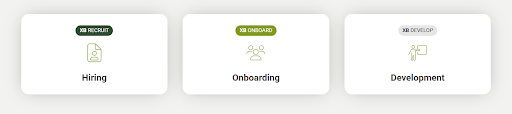
XBInsight’s AI + Science-powered platform brings those efforts into one cohesive system. XB Recruit strengthens the pipeline at the point of hire by aligning selection decisions with validated leadership competencies and critical thinking skills. XB Onboard supports early alignment by clarifying expectations and decision ownership from the start. XB Develop targets measurable capability gaps tied to future leadership roles. XB Succeed provides benchmarking and visibility into bench strength, helping organizations understand readiness levels and succession risk with greater precision.
When hiring, onboarding, development, and succession are connected through one integrated platform grounded in I/O psychology and data-driven insight, leadership strategy moves in a unified, strategic direction. Instead of managing separate programs, organizations gain a single framework that keeps competency initiatives aligned and advancing together. With XBInsight, you get one seamless platform for every talent decision.
Plan for Emergencies and Communicate Transparently
Even the strongest long-term succession plan can benefit from emergency preparedness. Organizations often identify interim leaders for critical roles and ensure they’re cross-trained to step in if needed. Reviewing emergency plans regularly keeps them aligned with structural or strategic changes.
Clear communication also strengthens succession planning. Potential successors benefit from constructive feedback about their readiness and development priorities. Transparency reduces uncertainty and aligns individual ambition with organizational opportunity.
Create a Succession-Ready Culture with XBInsight
Succession planning is most effective when it’s part of your organizational culture rather than treated as an occasional exercise. When leadership readiness is discussed openly, measured consistently, and aligned with strategic planning cycles, it becomes part of how the organization operates.
Leadership change is inevitable. When you approach succession with structure, foresight, and data, you’re better positioned to turn those transitions into moments of continuity and growth.
If you’re evaluating the health of your leadership pipeline and want clearer visibility into readiness and risk, XBInsight’s AI + Science-powered solutions can help you build a succession strategy grounded in measurable performance data and long-term business alignment.