Artificial intelligence has transformed the way organizations collect, organize, and interpret workforce data. It can uncover patterns across thousands of employees, identify trends that humans might overlook, and help leaders make decisions faster than ever before. For organizations navigating today’s talent challenges, those capabilities are undeniably valuable. But speed alone doesn’t improve decision quality.
When decisions involve hiring critical talent, developing future leaders, planning succession, or strengthening organizational performance, executives need confidence that the insights guiding those decisions are accurate, explainable, and predictive. AI can recognize patterns. It takes science to explain why those patterns exist and whether they truly predict future success.
That distinction becomes increasingly important as companies invest in AI-powered HR technology.
AI Excels at Finding Patterns
Succession planning used to revolve around identifying a few potential replacements for key leadership positions. An annual Artificial intelligence processes enormous volumes of information with remarkable efficiency. It can recognize relationships between skills, experience, performance metrics, engagement data, and countless other workforce variables in a matter of seconds.
For business leaders, this creates significant opportunities. AI can help identify candidates who resemble top performers. It can highlight employees who may be at risk of leaving. It can recognize workforce trends that support strategic planning and surface opportunities that would otherwise remain hidden within complex datasets.
These capabilities make AI an essential component of modern talent management. The challenge arises when organizations assume those patterns automatically explain performance or predict competencies.
A statistical relationship doesn’t necessarily reveal the underlying behaviors, capabilities, or motivations that drive success. Without understanding those factors, businesses risk making faster decisions instead of better ones.
High-Stakes Decisions Demand More Than Correlation
Every executive understands the cost of making the wrong talent decision. Hiring someone who looks qualified but struggles to perform can affect productivity, team morale, customer relationships, and profitability. Promoting an employee before they’re ready can create leadership gaps that ripple throughout an organization. Failing to identify future leaders early enough can weaken succession plans and disrupt long-term business continuity.
These aren’t simply HR challenges. They’re business challenges. The higher the stakes, the more important it becomes to understand why individuals succeed, not simply what characteristics they appear to share. That requires more than algorithms alone.
It requires scientifically-validated measurement that examines how people think, solve problems, make decisions, learn, adapt, and perform within the context of a specific role.
The Best Performance Systems Measure the Why
High-performing organizations rarely rely on surface-level metrics alone. In the world of NFL Officiating, for example, we see just how important having the right systems is on game day. Every game produces an extraordinary amount of performance data. Officials’ decisions, communication, positioning, timing, consistency, and accuracy can all be analyzed. Technology can quickly identify patterns across thousands of plays.
Those patterns are valuable, but they don’t tell the whole story. Understanding why an official consistently performs well under pressure requires a deeper evaluation of judgment, decision-making, communication, and learning agility that support consistent performance in demanding situations.
The same principle applies throughout business. Companies can identify employees who consistently outperform expectations. They can recognize teams with stronger engagement or departments with lower turnover. The real competitive advantage comes from understanding the measurable characteristics that produce those outcomes, allowing leaders to make more informed hiring, development, and succession decisions moving forward.
Why Scientific Validation Changes the Conversation
Scientific validation helps organizations determine whether the measurements being measured actually predict success in a specific role. AI can identify patterns in workforce data, but those patterns aren’t automatically proof of what drives performance.
Decades of Industrial-Organizational Psychology research provide a more rigorous foundation. Assessments can be systematically tested and validated to measure the cognitive capabilities, behavioral competencies, learning agility, and job-specific factors linked to performance.
This becomes especially important because AI models learn from historical workforce data. If that data reflects past hiring decisions influenced by outdated assumptions or bias, the AI may inadvertently perpetuate those same patterns rather than identify the true predictors of success. Scientifically validated assessments provide a more objective foundation by measuring the factors that have been shown to predict success in a specific role.
A scientifically validated assessment measures the job-relevant attributes that research has demonstrated predict success in a specific role, providing an objective evaluation that is independent of who previously held the position. The result is greater confidence that talent decisions are objective, predictive, and aligned with long-term business outcomes.
Talent Intelligence Should Continue Beyond Hiring
Change to: Scientific validation allows companies to determine whether the factors being measured actually predict success in a specific role. AI can identify patterns in workforce data, but those patterns alone do not demonstrate what truly drives performance.
Our decades of Industrial-Organizational Psychology research provide a rigorous scientific foundation for talent assessment. Through systematic validation, assessments can identify and measure the factors that are demonstrably linked to success in a specific role, including cognitive capabilities, behavioral competencies, learning agility, and other job-relevant predictors of performance.
Scientifically validated assessments help counter this risk by objectively measuring the factors that research has shown to predict success in a specific role, enabling organizations to make talent decisions based on evidence rather than historical precedent.
AI + Science Creates Better Business Decisions
Artificial intelligence shouldn’t replace human judgment. It should strengthen it. The most effective talent strategies combine AI’s ability to process information quickly with scientifically validated assessment methodologies that explain the factors driving performance, leadership potential, and organizational success.
That combination allows businesses to move beyond reactive talent management.
- Hiring becomes more predictive.
- Onboarding becomes more personalized.
- Employee development becomes more targeted.
- Succession planning becomes more objective.
The result isn’t simply more data. It’s better decision-making supported by evidence that leaders can trust.

A Connected Platform Creates Lasting Competitive Advantage
Organizations don’t compete based solely on the technology they implement. They compete based on the quality of the decisions that technology enables. That’s why leading businesses are shifting away from isolated HR tools toward connected talent intelligence platforms that generate meaningful insight across the entire employee lifecycle.
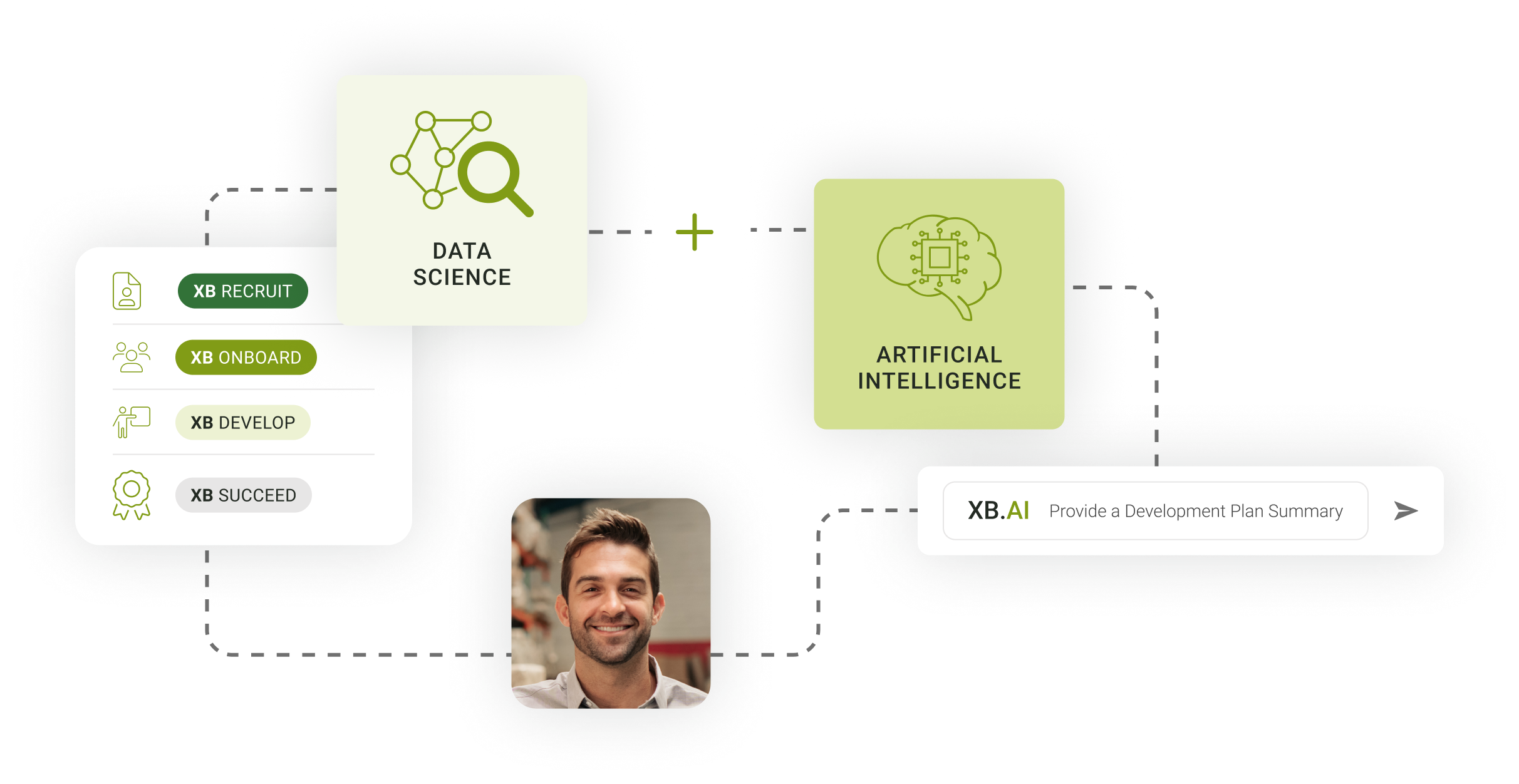
The XBInsight AI + Science-Powered Talent Decision Platform combines advanced AI with decades of scientifically validated Industrial-Organizational Psychology research to help organizations make smarter talent decisions from hire to retire. Rather than relying on disconnected assessments or standalone HR systems, the platform connects hiring, onboarding, employee development, and succession planning into one continuous source of workforce intelligence.
- Every talent decision contributes another layer of evidence.
- Every assessment strengthens future decisions.
And every stage of the employee lifecycle becomes your opportunity to build a stronger, more agile, and future-ready organization.
Want to explore a demo? Contact our team.