

A promotion decision can shape far more than one employee’s career. It can affect team performance, leadership capacity, retention, succession plans, and the strength of the internal talent pipeline.
That puts considerable weight on how leaders decide who is ready to move up.
Performance reviews, business results, manager recommendations, experience, and career history all provide valuable information. But promotions introduce new responsibilities and expectations that may never have been tested in an employee’s current position.
Assessment data gives leaders another source of evidence for evaluating that move. Used alongside performance and business context, it can provide a clearer picture of readiness, reduce reliance on subjective interpretation, and reveal strengths or gaps that might otherwise become apparent only after someone has been promoted.
Better Promotion Decisions Build Stronger Organizations
Every internal promotion creates a ripple effect.
When an employee succeeds at the next level, the company gains leadership capacity while creating room for other employees to grow. Internal mobility becomes easier to support, succession pipelines become stronger, and talented employees can see opportunities to build their careers without leaving the business.
A poor promotion decision can create its own ripple effect. Someone who excels as an individual contributor, technical expert, or frontline manager may struggle when the job suddenly requires broader decision-making, strategic thinking, people leadership, or accountability for results beyond their previous scope.
Those challenges rarely stay confined to the newly promoted employee. They can affect the people they lead, the results they own, and the executives who now need to address the gap.
Better data before the decision gives leaders a chance to understand readiness before those consequences unfold.
Further reading: The Hidden Cost of Promoting the Wrong People in 2027
Past Performance Only Tells Part of the Story
Performance is an important promotion signal for good reason. Leaders should know whether an employee consistently delivers results, demonstrates expertise, follows through on responsibilities, and contributes to the business.
The limits appear when those accomplishments are treated as evidence that someone will perform equally well under different demands.
Promotion can fundamentally change the nature of the work. The strongest salesperson may now need to coach a sales team. A highly effective functional manager may be moving into an enterprise leadership position. Someone accustomed to executing a defined strategy may suddenly be responsible for shaping one.
The capabilities that produced strong results in one position don’t always reveal how someone will respond to greater complexity, ambiguity, influence, or accountability.
Assessment data can help fill in those gaps. It provides leaders with information specifically designed to evaluate the individual’s readiness for the demands of a new role, rather than relying on current-role performance to predict something it was never designed to measure.
More Objective Data Creates a Stronger Decision
Promotion discussions inevitably include human judgment. Managers have firsthand knowledge of their employees, executives understand business needs, and talent leaders bring valuable context about development and succession.
The challenge is that people can interpret readiness differently.
One manager may value technical expertise. Another may prioritize executive presence. High-visibility employees can attract more attention during talent discussions, while equally capable people may be less visible outside their immediate teams. Recent successes, difficult projects, personal relationships, or individual leadership preferences can also shape perceptions.
Cross-functional reviews and calibration sessions can broaden the conversation, but the people in the room still need meaningful evidence to evaluate.
Scientifically grounded assessment data gives them a more consistent reference point. Rather than relying solely on individual interpretations of who “looks ready,” leaders can incorporate data about capabilities and readiness into the discussion.
That can make promotion decisions more consistent while still leaving room for the professional judgment and business context leaders need to apply.
Data Can Surface Strengths and Risks That Aren’t Obvious
Some promotion candidates are easy to identify. They consistently perform, actively pursue advancement, and have leaders advocating for them.
Other talent is easier to miss.
An employee may have strong potential without being the most visible person in the room. Someone with impressive results may have gaps that become more significant as responsibility increases. Another candidate may possess many of the capabilities required for advancement but need focused development in a specific area before taking the next step.
Those distinctions can be difficult to uncover through performance reviews and recommendations alone.
Assessment data creates another opportunity to see what sits beneath the existing talent narrative. Leaders can identify capabilities that support advancement, uncover areas that warrant closer attention, and make more informed comparisons among employees being considered for greater responsibility.
That visibility is particularly valuable in succession planning, where leadership teams need to understand the depth of their pipeline rather than simply maintain a list of familiar names.
Promotion Data Can Make Development More Precise
Not every strong employee will be ready for advancement at the moment an opportunity appears. Knowing why can make the difference between a vague “not yet” and a useful development plan.
Without deeper insight, employees may hear that they need more leadership experience, greater strategic thinking, or additional time in their current role. Those recommendations leave considerable room for interpretation.
Assessment results can help narrow the gaps.
A candidate may need opportunities to make decisions under greater ambiguity. Another may benefit from developing specific leadership competencies. Someone else may have the necessary capabilities but need experience operating with broader scope or influence.
That gives managers and talent leaders more information for deciding where coaching, assignments, experiences, or other development investments could have the greatest value.
It also improves the next promotion conversation. Instead of starting over each time a position opens, leaders can track development against areas that have already been identified.
The Best Promotion Data Looks at Next-Level Readiness
The value of assessment data depends heavily on what is being assessed.
A general personality profile or another measure of current performance won’t necessarily tell leaders what they need to know about advancement. Promotion decisions call for insight into the capabilities associated with succeeding at a higher level.
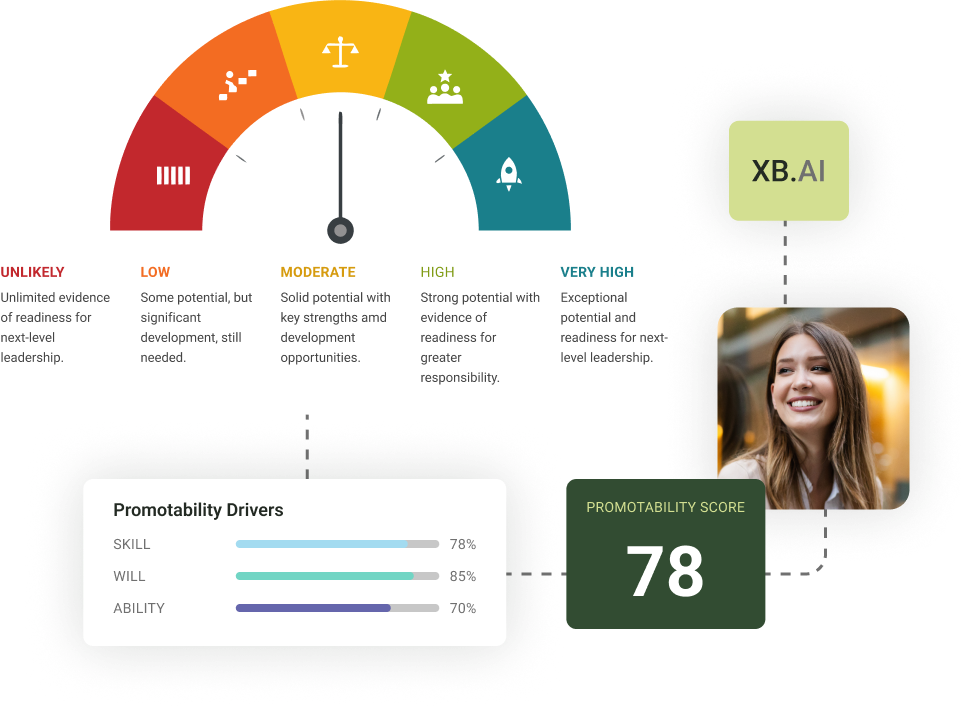
XBInsight approaches that question through Ability, Skill, and Will, three dimensions that provide a multidimensional view of leadership readiness.
Ability examines whether an individual has the cognitive capacity to navigate increased complexity, ambiguity, problem-solving, decision-making, and strategic demands.
Skill examines the learned and observable leadership competencies required as responsibilities, scope, and expectations expand.
Will examines the motivation to accept the visibility, influence, accountability, ambiguity, and tradeoffs that accompany greater leadership responsibility.
Together, these dimensions help leaders evaluate more than an employee’s track record. They provide insight into how prepared that individual may be for the demands associated with advancement.
A Promotability Score Brings the Data Together
XBInsight’s Leadership Readiness & Promotability Report takes those insights further by bringing multiple sources of talent data into a more complete view of readiness.
At the center is the Promotability Score, which is anchored to the requirements of the target role. That distinction gives the score practical value in an actual promotion decision because leadership readiness isn’t evaluated against a generic idea of what makes someone successful. The data is considered in relation to the level and demands the individual is preparing to enter.
Insights into fit and potential derailers add another layer, helping leaders identify factors that could interfere with successful advancement even when other indicators appear strong.
The result is an innovative approach to measuring promotability that gives executives and talent leaders a science-based way to examine a question they already have to answer: Who is ready to move up?
And when someone isn’t ready today, the same data can help clarify where development is needed and what support or experiences could better prepare them for a future opportunity.
For companies building leadership pipelines, that means promotion decisions can become more informed, development investments more targeted, and succession planning more grounded in evidence about the talent already inside the business.
Put Better Data Behind Your Next Promotion Decision
Promotion decisions will always require judgment. The quality of that judgment improves when leaders have stronger evidence behind it.
XBInsight combines AI with 20+ years of I/O psychology research and scientifically validated talent assessments to help companies make more informed decisions across the employee lifecycle. The Leadership Readiness & Promotability Report extends that science into one of the most consequential talent decisions a company makes: deciding who is ready for greater responsibility.
See how XBInsight can bring greater confidence and clarity to your promotion and succession decisions. Request a demo today.