

Ask five executives who’s ready for the next leadership role, and you may get five different answers.
One points to the person with the strongest performance record. Another favors someone who’s been with the company for years. Someone else sees leadership potential in an employee who’s taken on bigger projects. Then there’s the leader who says, “I’ve worked with her. She’s ready.”
Those perspectives aren’t necessarily wrong, they’re simply measuring different aspects of talent. Potential, performance, and readiness for the next level are not the same thing.
Organizations have traditionally made promotion decisions using some combination of performance, experience, manager recommendations, talent reviews, and human judgment. All of those inputs can tell you something about an employee’s skills in a current role. But as organizations focus more heavily on succession planning and building stronger leadership pipelines, there’s another question worth asking:
Can we measure leadership readiness more consistently and for the roles we need them to fill?
The science says we can.
How Have Organizations Traditionally Evaluated Leadership Readiness?
There’s usually plenty of information available when someone’s being considered for advancement.
Leaders can look at performance ratings, career history, tenure, past accomplishments, feedback, and development progress. They can ask managers who they believe are ready or discuss potential successors during talent reviews.
The challenge starts when those inputs become interchangeable measures of readiness.
Recent SHRM commentary on building future-ready leadership pipelines points to the same challenge. Organizations can still rely on first impressions, gut feelings, or legacy promotion models when identifying high-potential leaders. SHRM recommends clearer leadership-potential benchmarks and more objective, measurable processes to help organizations identify and develop talent.
That doesn’t mean leaders should hand over promotion decisions to data alone. Their experience, judgment, and knowledge of their people remain essential. What science can provide is a more consistent, objective lens for evaluating what they’re seeing, helping leaders distinguish performance and potential from true readiness for what’s next.
High Performance Tells You What Someone Has Already Done
It’s easy to understand why performance carries so much weight in promotion decisions. When someone consistently delivers results, knows the business, earns trust, and exceeds expectations, moving that person up can feel like the obvious next step.
But performance tells you how successfully someone is doing the job they have now.
Leadership readiness asks something different: Is this person equipped for the demands of the next role?
Gallup’s 2026 research on frontline supervisors shows how easily those two questions can get mixed together. Among the supervisors surveyed, 65% said they got the position based on their frontline performance or years of experience. Only 30% said supervisory skills, previous supervisory experience, or beginning their career as a supervisor played that role. Gallup also found lower engagement among supervisors who moved up based on frontline performance or experience than among those selected based on supervisory skills or experience.
The same basic challenge can show up throughout the leadership pipeline and across industries.
As responsibilities grow, the job changes. Decisions become more complex. There’s more ambiguity to navigate, more influence required across teams, and more accountability for outcomes beyond an individual leader’s own work.
A strong performance record is useful evidence. It just can’t tell you everything you need to know about readiness for a different role.
Measuring Leadership Readiness Starts with the Role
There’s another problem with trying to identify “leadership potential” without more context.
Potential for what?
People aren’t promoted into a generic idea of leadership. They step into roles with specific expectations, responsibilities, challenges, and definitions of success.
Yet Gartner reported that only 32% of HR leaders measure successor readiness by assessing alignment with critical role success profiles.
That suggests a better place to start. Before asking who looks ready, define what readiness means for the role ahead.
What will the next level ask of this person that the current role doesn’t? Which competencies become more important? How much additional complexity will they need to manage? What kind of decisions will they make? What could get in the way of their success?
Once those requirements are clear, leaders can evaluate an individual against the specific demands of the next role, not simply a general sense that they “have potential.”
Further reading: Can Promotability Be Measured?
What Does the Science of Leadership Readiness Measure?
There isn’t one trait that suddenly makes someone ready to lead at the next level.
A leader can have strong competencies but struggle with the increased cognitive demands of a more complex role. Someone else may have plenty of capability and experience but little appetite for the visibility, ambiguity, accountability, or tradeoffs that come with greater responsibility.
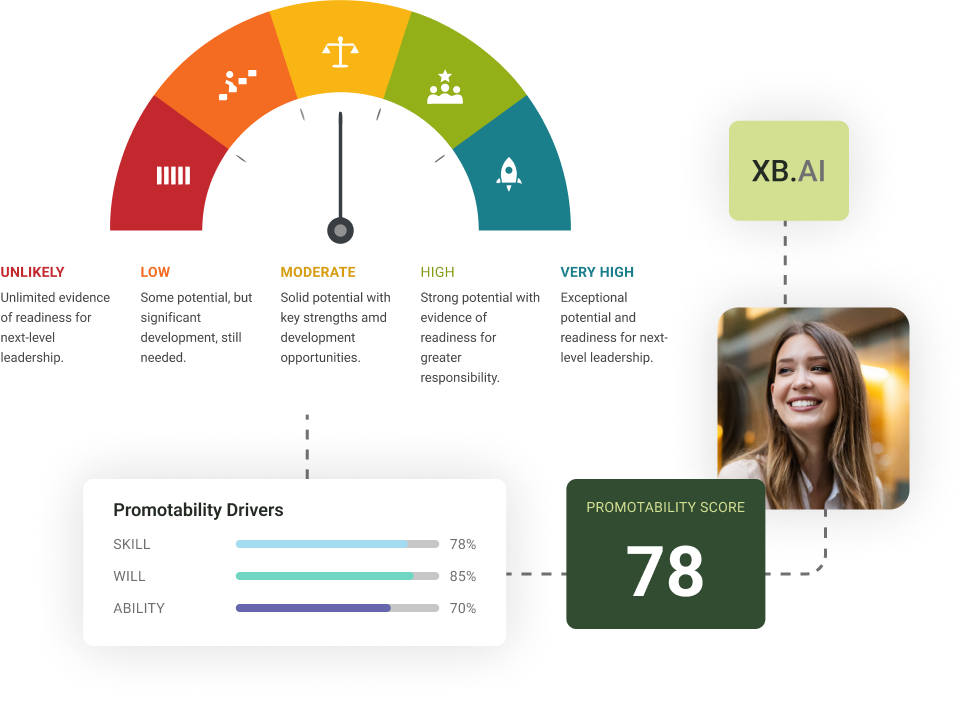
That’s where XBInsight’s approach to understanding leadership readiness comes in. We measure three critical dimensions, Ability, Skill, and Will to understand whether someone has what it takes, has demonstrated what the next role requires, and is motivated to take it on.
Ability: Can They Handle It?
Ability measures the cognitive capacity needed to navigate greater complexity, ambiguity, problem-solving, and strategic demands.
As roles become more complex, leaders aren’t simply being asked to do more work. They may need to process more information, make decisions with less certainty, and solve problems with broader organizational consequences.
Skill: Can They Do It?
Skill at the learned, observable leadership competencies that become increasingly important as responsibilities expand.
Someone may be excellent at the competencies their current position requires but still have areas to develop before stepping into a role with different expectations.
That’s useful information before the promotion happens.
Will: Do They Want It?
Will goes deeper than asking whether someone wants a bigger title or a promotion.
As leadership responsibility increases, so do the demands for visibility, influence, accountability, ambiguity, and difficult tradeoffs. Will measures the individual’s motivation and willingness to take on what the next level actually requires.
That distinction can be easy to miss in a traditional promotion conversation. Wanting career growth and wanting the realities of a particular leadership role aren’t always the same thing.
Together, Ability, Skill, and Will provide a more complete picture of whether an individual is ready to step into the role ahead.
Role Fit Gives Leadership Potential Somewhere to Land
Ability, Skill, and Will still don’t exist in a vacuum. Readiness has to connect to the role.
XBInsight also examines fit with the role ahead and potential derailers that could get in the way of success. Together, these insights help organizations understand not just whether someone has potential, but whether that potential aligns with the demands of the role they may step into.
It also creates an important distinction between potential and promotability.
Potential can be broad. Promotability asks a much more specific question. Does this individual have the Ability, Skill, and Will to take on the demands of the next role, and where might development still be needed?
That’s much more actionable than simply identifying someone as “high potential.”
What Changes When Leadership Readiness Becomes Data?
This is where talent science can make promotion conversations more useful.
XBInsight’s Leadership Readiness & Promotability Report brings multiple dimensions of talent data together into a Promotability Score, providing an innovative approach to measuring promotability and a science-based view of an individual’s readiness for the role ahead.
The report measures Ability, Skill, and Will, along with fit for the role ahead and potential derailers that could impact success. Rather than relying on a single indicator of potential, it provides leaders with a more complete, role-specific view of the factors that inform promotion and succession decisions.
That can change what happens around the talent table.
If a leader believes someone’s ready, there’s data to explore alongside that judgment. If the team agrees someone has long-term leadership potential but isn’t ready yet, the conversation can turn toward the areas that need development.
Succession planning becomes more than identifying names for future roles. Organizations can get a clearer picture of who may be ready now, where targeted leadership development could make a difference, and where the leadership pipeline may need more attention.
Better Data Makes Human Judgment More Informed
No single score should make a promotion decision. The Promotability Score gives leaders another data-informed perspective to consider alongside their experience, judgment, and knowledge of the individual.
Science adds structured evidence designed for the decision they’re trying to make. And when several executives are evaluating leadership potential together, a shared framework can give everyone the same data to work with, even when their individual perspectives differ.
XBInsight combines AI with more than 20 years of Industrial-Organizational Psychology research and scientifically validated talent assessments to help organizations make more informed talent decisions.
The Leadership Readiness & Promotability Report brings that science to one of the hardest questions in promotion decisions and succession planning:
Who’s ready for what’s next?
Bring More Science to Your Next Promotion Decision
See how the XBInsight Leadership Readiness & Promotability Report can bring science-backed talent data and greater consistency to your promotion, succession, and leadership development decisions.
Explore the Leadership Readiness & Promotability Report, and request a demo.